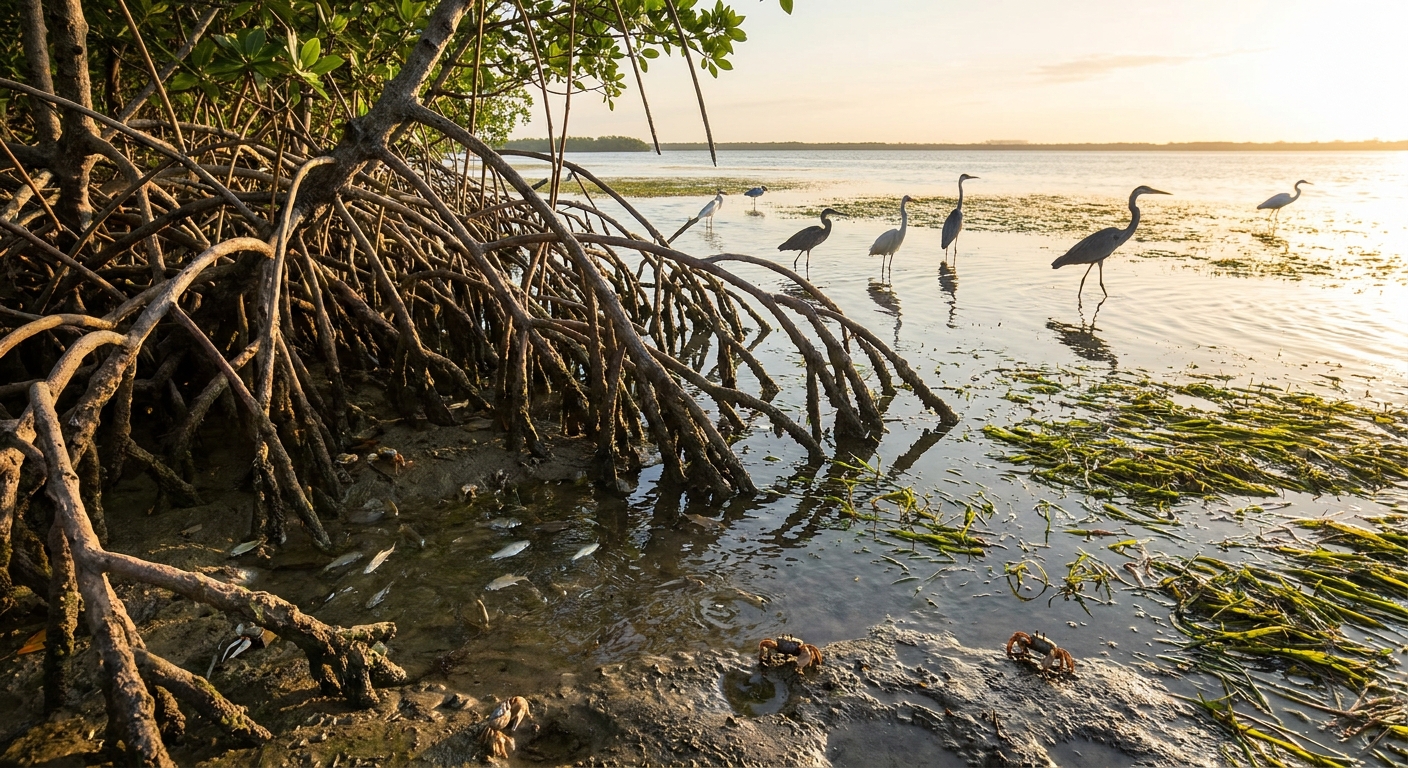
Walk along any tide line at low water and you’re standing above one of the ocean’s great nurseries. From microscopic larvae to juvenile sharks, a huge fraction of marine life depends on coastal ecosystems to get through its most vulnerable life stages.
The Coast as a Cradle for Marine Biodiversity
In recent decades, tagging technologies, genetic tools, and satellite data have allowed marine biologists to follow larvae and juveniles in ways that were impossible a generation ago. The result: a clearer, more quantitative picture of just how important coasts are as nurseries—and how different habitats play distinct developmental roles.
This guide walks through the major coastal nursery habitats and what current research tells us about how they grow ocean life.
1. Estuaries: Turbulent Training Grounds
Estuaries mix fresh and saltwater, producing steep gradients in salinity, turbidity, and nutrients. For early life stages, that variability is not a bug—it’s a selective filter.
Why Estuaries Make Effective Nurseries
- Predator dilution: Turbid water and structural complexity (roots, pilings, channels) can hide small fish and invertebrates from visual predators.
- High productivity: Phytoplankton blooms and detritus support dense zooplankton populations, offering abundant food.
- Physiological training: Organisms that survive estuarine variability tend to be robust, better equipped for later life in open coastal or reef waters.
Recent Findings
- Acoustic telemetry on juvenile salmon, snook, and flatfish shows that time spent in estuaries is often a better predictor of adult survival than ocean conditions alone.
- A 2021 meta-analysis of estuarine fish densities found that for many commercially important species, juveniles were 2–10 times more abundant in estuaries than in adjacent coastal waters.
2. Mangroves: Root Mazes for Young Reef Fish
Mangrove forests straddling the intertidal zone are famously labyrinthine—an architectural gift for juvenile fish.
Structural Refuge
The root systems of mangroves:
- Provide three-dimensional shelter from predators
- Offer surface area for algae, sponges, and invertebrates, creating feeding hotspots
- Slow water flow, reducing energetic costs for small fish
Species Profile: The Mangrove Snapper (Lutjanus griseus)
Mangrove snappers start life offshore, then settle into mangroves as juveniles before joining adult populations on reefs and deeper coastal areas.
Key research insights:
- Otolith microchemistry reveals clear mangrove signatures in many adult snappers, proving their nursery origin.
- Protected mangrove bays show higher contributions of mangrove-reared individuals to offshore fisheries compared to deforested coasts.
Connectivity with Coral Reefs
A 2020 Caribbean-wide study combining fish surveys, genetic markers, and habitat mapping demonstrated that coral reefs near intact mangroves had considerably higher biomass of some commercial species, emphasizing mangroves as feeders of reef fish stocks.
3. Seagrass Meadows: Feeding Grounds and Safe Corridors
Seagrass meadows often go unnoticed beneath the chop of shallow bays, but for juveniles their blades are both camouflage and cafeteria.
Nursery Benefits
- High invertebrate diversity (amphipods, small crustaceans, worms) provides abundant prey.
- Dense blades distort predator attack trajectories and limit visibility.
- Meadows function as stepping-stone habitats, allowing juveniles to move gradually from sheltered bays to more exposed coasts.
Recent Research on Seagrass Nurseries
- A 2022 global synthesis found that over 20% of the world’s largest fisheries target species that use seagrass as nursery habitat.
- Experiments using artificial seagrass reveal that structural complexity alone explains much of the refuge effect, though natural meadows add additional food and microhabitats.
Species that use seagrass nurseries include cod, whiting, various flatfishes, and in some regions, juvenile green turtles grazing on epiphytic algae.
4. Salt Marshes and Mudflats: Hidden Productivity Hotspots
Salt marshes and mudflats may look barren at first glance, but under the surface they are teeming.
Invertebrate Nurseries
- Burrowing worms, clams, and crustaceans spawn in marsh channels and mudflats.
- Many spend their larval stages in the water column before returning to settle in the sediments.
These invertebrates, in turn, feed enormous numbers of juvenile fish and migratory shorebirds. Recent drone-based surveys combined with benthic sampling have revealed fine-scale patchiness in invertebrate distribution, closely tied to microtopography and sediment grain size.
Fish and Crustaceans
Species like juvenile blue crabs, killifish, mullet, and various gobies use marsh creeks and tidal pools during different tide stages. Time-lapse camera traps have helped scientists document tidal migrations—mini-treks undertaken multiple times per day as animals follow the moving waterline.
5. Rocky Shores and Tide Pools: Microcosms of Adaptation
Rocky coasts seem harsh—wave-battered, desiccating in the sun—but tide pools and crevices function as micro-nurseries for many intertidal and shallow subtidal organisms.
Larval Settlement Zone
For barnacles, mussels, anemones, and some algae:
- Larvae disperse offshore, sometimes for weeks.
- Chemical cues (from biofilms, adult conspecifics, or specific rock types) guide them back to the shore.
- Tide pools provide stable enough conditions for metamorphosis and early growth.
Recent molecular work has shown just how selective this process can be: larvae may respond to species-specific bacterial communities in biofilms, meaning that microbial assemblages indirectly shape rocky-shore communities.
6. Climate Change and the Shifting Geography of Nurseries
As oceans warm and sea levels rise, nursery habitats are on the move.
Poleward Shifts
- Seagrass and some mangrove species are expanding into higher latitudes where winter temperatures are now milder.
- This allows new nursery areas to develop—but often at the expense of existing temperate salt marshes.
Depth Changes
- Warming and turbidity can push suitable nursery zones slightly deeper.
- Larval and juvenile distributions are tracking these changes, as seen in multi-decade trawl survey datasets.
A 2023 modeling study coupled larval dispersal with climate scenarios and found that without proactive habitat protection inland (to accommodate horizontal migration) and offshore (for vertical shifts), many nursery networks could fragment, reducing overall recruitment.
7. Designing Better Conservation from a Nursery Perspective
If coasts are nurseries, then effective conservation must protect not just adult habitats but the full life-cycle seascape.
Key Management Principles Emerging from Recent Science
Protect habitat mosaics, not single sites
Juveniles often move among estuaries, mangroves, and seagrass over weeks to months.
Maintain connectivity
Breaks in habitat corridors—like hardened shorelines and polluted zones—can disrupt juvenile movements and reduce survival.
Time closures to life cycles
Seasonal fishing closures aligned with peak juvenile presence in coastal nurseries can significantly boost stock recovery.
Incorporate nursery value into marine spatial planning
New models integrate larval production, juvenile density, and habitat quality to map “nursery value” for priority protection.
8. How Enthusiasts Can Help Protect Coastal Nurseries
- Support restoration projects that rebuild seagrass, mangroves, and marshes.
- Participate in juvenile fish and invertebrate surveys through citizen-science programs.
- Advocate for water quality: reduced nutrient runoff and better wastewater treatment directly improve nursery survival.
- When diving or snorkeling, treat shallow vegetated areas as critical habitat, not just the prelude to a more photogenic reef.
The next time you stand at the shore, imagine the invisible cohort of larvae and juveniles using that margin as a launchpad to the wider ocean. Coastal nurseries are not just scenic—they are the demographic engines that keep marine populations, and our fisheries, alive.