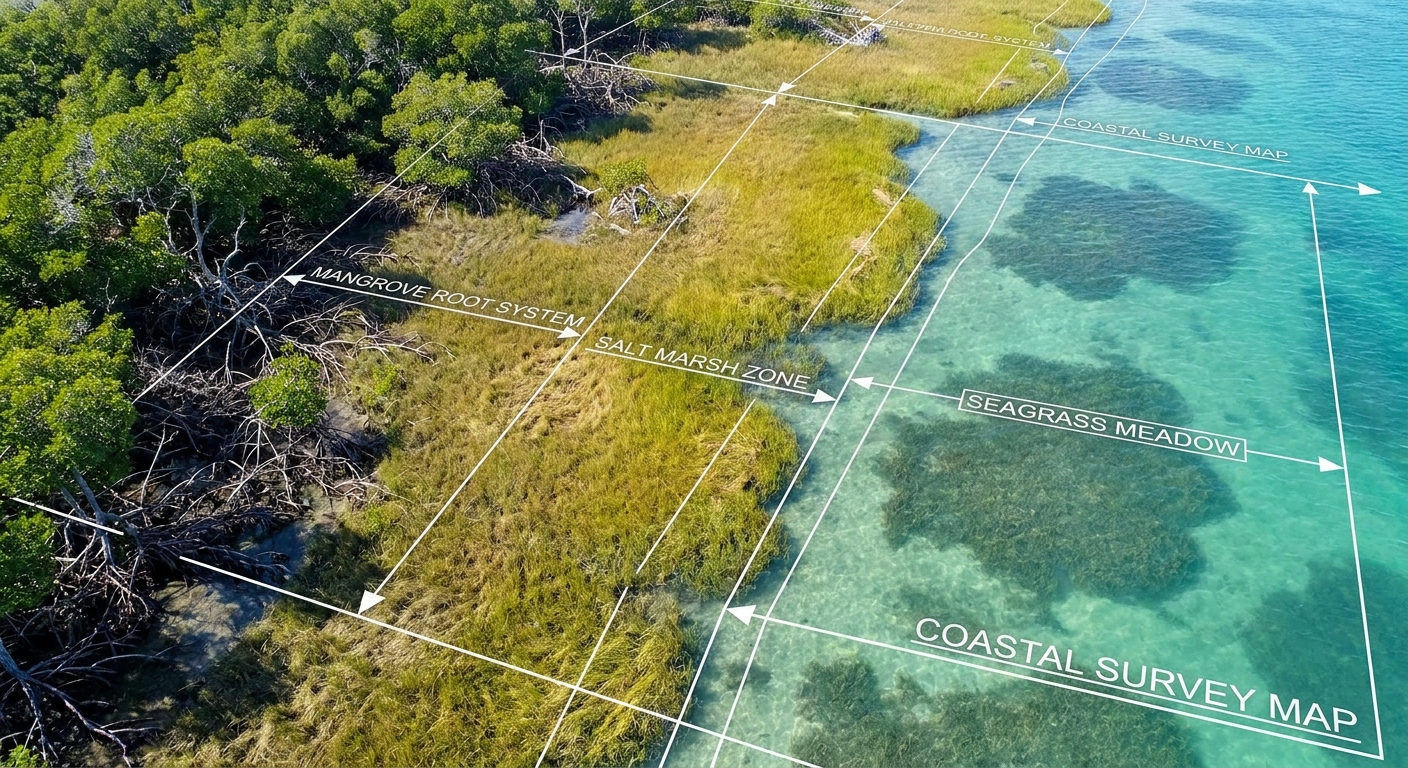
Coastal protection and carbon storage are often discussed under the umbrella term blue carbon, but not all blue carbon ecosystems are built alike. Mangrove forests, salt marshes, and seagrass meadows are three distinct engineering solutions evolved to solve the same problems: how to live in salty, dynamic, low-oxygen environments and still build stable, productive communities.
Three Coastal Architects, Three Different Designs
For ocean enthusiasts, comparing these systems side by side reveals an elegant set of ecological trade-offs and complementary strengths.
Habitat at a Glance
| Feature | Mangroves | Salt Marshes | Seagrass Meadows |
|---|---|---|---|
| Dominant plants | Woody trees/shrubs | Herbaceous grasses/sedges | Submerged flowering plants |
| Typical position | Tropical/subtropical intertidal | Temperate/subpolar intertidal | Subtidal to intertidal, global |
| Substrate | Soft, anoxic mud/sand | Mud/sand, often fine sediments | Sand, mud, mixed; below waterline |
| Main stressors | Salinity, flooding, sulfide | Salinity, freezing, desiccation | Salinity, light limitation, burial |
| Key ecosystem service | Coastal defense & nursery habitat | Coastal defense & nutrient retention | Sediment stabilization & habitat |
Mangroves: Vertical Solutions to a Flooded World
Mangroves are woody plants that have repeatedly evolved the ability to live where most trees die: in salty, waterlogged soils. They employ a combination of structural, physiological, and symbiotic strategies.
Structural Engineering
- Prop roots and pneumatophores: Above-ground root structures stabilize sediments and allow gas exchange in low-oxygen muds.
- Canopy stratification: Multiple layers intercept wind and waves, reducing energy before it reaches inland areas.
Physiological Tricks
- Salt-filtering roots and salt-excreting leaves
- Specialized water-conducting tissues to handle osmotic stress
Blue Carbon and Biodiversity
- Mangrove soils can store carbon for millennia, with some cores showing uninterrupted accumulation over 6,000+ years.
- They support crabs, mollusks, juvenile reef fish, birds, and even arboreal species like monkeys and bats in some regions.
Recent LiDAR-based biomass estimates (2021–2023) highlight that tall, riverine mangroves store disproportionately large amounts of above-ground carbon compared to scrubby, fringe mangroves—important when prioritizing conservation.
Salt Marshes: Horizontal Fortresses of the Temperate Zone
Salt marshes dominate many temperate coasts, building flat, grassy fortresses against the sea.
Structural Engineering
- Dense, fibrous root mats bind sediment and promote vertical accretion as plant matter and suspended particles accumulate.
- Vegetation attenuates waves and slows overland flow during storm surges.
Coping with Stress
- Many marsh plants tolerate both salt and occasional freshwater pulses.
- Above the waterline, they face freeze–thaw cycles and desiccation that tropical mangroves rarely encounter.
Blue Carbon and Nutrient Cycling
- Salt marsh soils can store carbon at rates comparable to mangroves, especially in rapidly accreting systems.
- Marshes are powerful nitrogen filters, taking up reactive nitrogen and, via microbial denitrification, returning it to the atmosphere as N₂.
A 2022 global assessment revealed that restored salt marshes can recover carbon burial rates on the order of decades, much faster than peatlands or many terrestrial forests.
Seagrass Meadows: Underwater Meshworks
Unlike mangroves and marsh plants, seagrasses are fully submerged, forming meadows beneath the waves.
Structural Engineering
- Rhizome networks create an interlocking mesh that stabilizes sediments much like geotextile fabric.
- Canopies reduce current velocity and allow fine particles to settle.
Life Underwater
- Seagrasses require light, making them sensitive to turbidity.
- They host lush epiphytic communities—algae, invertebrates, and microbes living on leaf surfaces.
Blue Carbon and Biogeochemistry
- By slowing water and trapping particles, seagrasses promote long-term carbon burial in underlying sediments.
- They also influence local pH and oxygen dynamics; dense meadows can temporarily ameliorate ocean acidification in their immediate vicinity.
A 2023 study using carbonate chemistry sensors in eelgrass beds found daily pH swings large enough to buffer nearby shellfish from corrosive conditions during peak photosynthesis periods.
Similar Roles, Different Strengths
Although their architectures differ, these habitats share key ecological roles:
Wave and Storm Protection
- Mangroves: Most effective against longer-period waves and storm surges. - Salt marshes: Excel at reducing wave height across broad, shallow platforms. - Seagrass: Diminish bed shear stress and erosion, especially in combination with other features.
Nursery Habitat
- Mangroves: Critical for juvenile reef fishes and crabs. - Marshes: Important for juvenile finfish and crustaceans in temperate zones. - Seagrass: Global nursery for a multitude of fish and invertebrates.
Water Quality Improvement
- All three trap particles and influence nutrient cycling, but salt marshes shine in nitrogen removal, while seagrasses strongly affect turbidity.
Threats: Different Vulnerabilities on the Same Coasts
Mangroves
- Cleared for shrimp aquaculture, coastal development, and charcoal.
- Vulnerable to sea-level rise where landward migration is blocked by infrastructure.
Salt Marshes
- Drained, diked, or converted to agriculture and urban land.
- Subsidence and accelerated sea-level rise can drown marshes that cannot build vertically fast enough.
Seagrass Meadows
- Damaged by boat propellers, dredging, and trawling.
- Suffer from light limitation due to eutrophication and sediment plumes.
- Mangroves: ~20–35% lost
- Salt marshes: ~30–50% lost
- Seagrass: ~30% documented loss, with likely underestimation due to poor historical mapping
A comparative 2021 analysis estimated global losses since the mid-20th century at roughly:
Restoration: Matching Tools to Habitat Type
Mangrove Restoration
Past failures often came from planting the wrong species in the wrong place, like putting mangroves on open mudflats where hydrodynamics won’t support them.
Best practices now emphasize:
- Restoring natural tidal flows first
- Allowing natural recruitment where possible
- Planting species matched to micro-elevation and salinity regimes
Salt Marsh Restoration
Key interventions include:
- Breaching dikes to restore tidal exchange
- Reestablishing natural creek networks
- Sediment augmentation in subsiding marshes
Seagrass Restoration
- Transplanting seagrass sods or seeding with collected flowering shoots.
- Improving water quality to ensure enough light—often the prerequisite for successful planting.
Recent large-scale projects, like the eelgrass restoration in Virginia’s coastal bays, demonstrate that with the right conditions, seagrass can rapidly recolonize and build self-sustaining meadows that bring back fish, invertebrates, and birds.
Toward Integrated Coastal Design
Comparing these habitats highlights a central point: no single coastal ecosystem is a silver bullet. Their strengths are complementary:
- Mangroves excel in tropical storm defense and fish nurseries.
- Salt marshes dominate in temperate nutrient filtering and carbon burial.
- Seagrasses tie the shallow subtidal together, stabilizing sediments and supporting food webs.
Forward-looking coastal planning is increasingly embracing mosaic thinking—combining mangroves or marshes with seagrass beds, oyster or coral reefs, and carefully chosen built structures to create resilient shorelines.
For marine biology fans, these three blue carbon systems are a vivid demonstration of convergent evolution under physical constraint: three different blueprints, all solving the same grand engineering challenge at the ocean’s edge.