Coral reefs occupy less than 1% of the ocean floor but support an estimated 25% of all marine species. That statistic alone is enough to draw fascination—but the real story lies in the dynamic competition on every square centimeter of reef.
The Tipping Points Beneath the Waves
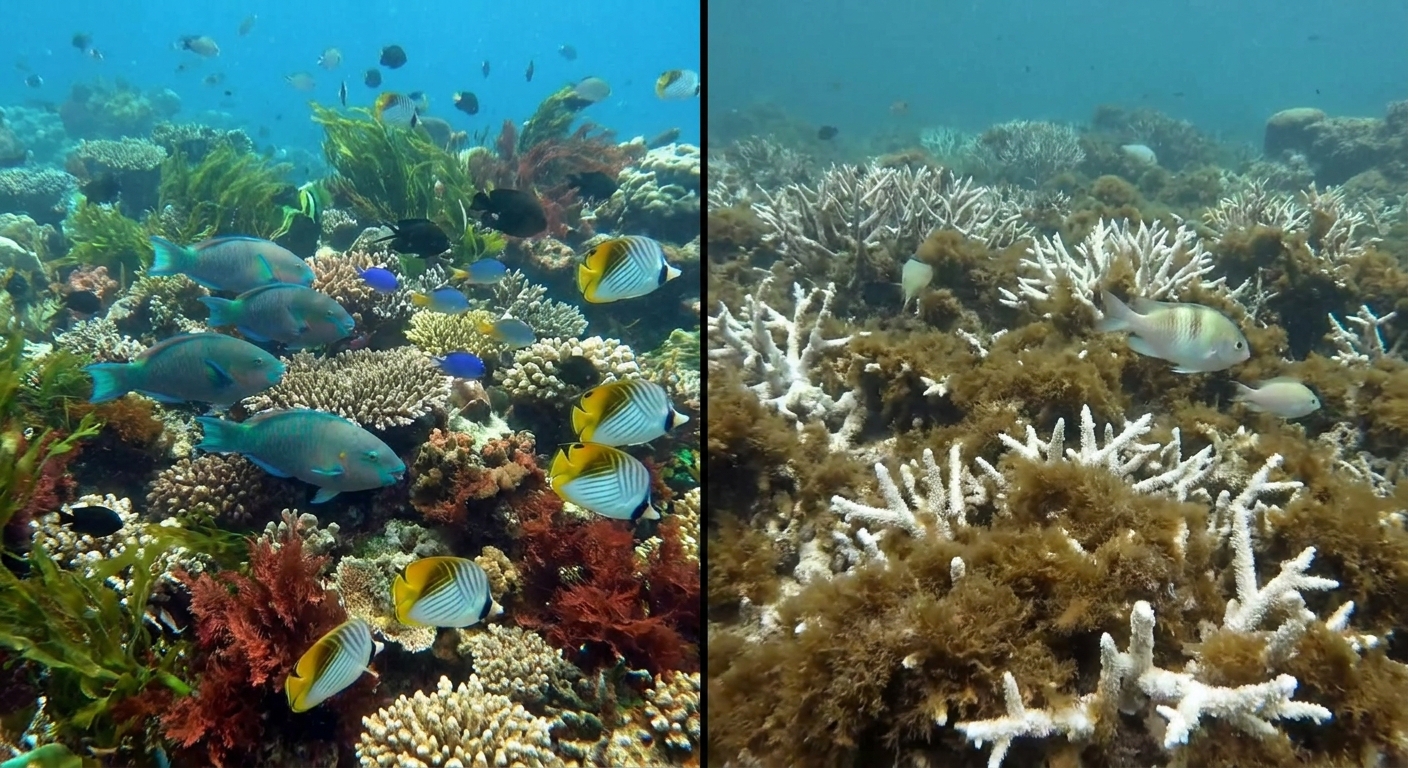
Reefs can exist in two dramatically different states:
- Coral-dominated: complex, three-dimensional structures buzzing with life
- Algae-dominated: flatter, smothered landscapes with reduced biodiversity
Conservation today is, in many ways, an effort to keep reefs on the coral side of that balance.
The Coral–Algae Arms Race
What Corals Need to Win
Corals are colonial animals that build calcium carbonate skeletons. Inside their tissues live symbiotic algae (zooxanthellae) that photosynthesize and provide energy. To compete with algae, corals rely on:
- Clear water for light
- Low to moderate nutrient levels
- Balanced herbivore populations (especially grazing fish and urchins)
Disturbances like pollution, overfishing, and heat stress tip the scales toward algae, which can grow rapidly on open space after coral death.
When Algae Take Over
Macroalgae can:
- Shade and physically overgrow corals
- Release allelopathic chemicals that inhibit coral larvae settlement
- Trap sediments that further smother reefs
Recent experiments in the Caribbean and Pacific show that even short-lived algal blooms can leave lasting chemical footprints on reef surfaces, making it harder for corals to return.
Key Species: The Herbivores That Hold the Line
Parrotfish: Bioeroders and Gardeners
Parrotfish are often described as reef gardeners, but they are also powerful bioeroders. By scraping algae (and some coral) off surfaces, they:
- Keep algal growth in check
- Create fresh "recruitment space" for coral larvae
- Contribute to sand production through the digestion of carbonate rock
A 2020 study of Caribbean reefs revealed that reefs with healthy parrotfish populations were far less likely to experience permanent shifts to algal dominance after bleaching events.
Sea Urchins: Comeback of a Keystone
In the early 1980s, a mysterious disease wiped out populations of the long-spined sea urchin Diadema antillarum across the Caribbean. The result was explosive algal growth and accelerated coral decline.
Recent work shows:
- Localized recoveries of Diadema can lead to rapid algal reduction and increased coral recruitment.
- Active restoration and outplanting of urchins is being tested as a management tool.
Yet, urchins can themselves become problematic if predator fish are overfished, illustrating the delicate web of reef interactions.
Heat, Bleaching, and the Search for Heat-Tolerant Corals
What Bleaching Really Is
Coral bleaching occurs when corals, stressed by heat or other factors, expel their symbiotic algae. Without these symbionts, corals lose much of their color and energy source.
Key insights from recent research:
- Bleaching thresholds are often around 1–2°C above the usual maximum for prolonged periods.
- Not all corals or symbionts are equal—some combinations are naturally more heat tolerant.
Assisted Evolution: A Bold Experiment
Researchers are experimenting with "assisted evolution" to boost coral resilience:
- Selective breeding of corals that survived past heatwaves
- Cross-breeding corals from warmer and cooler regions
- Manipulating and selecting heat-tolerant symbiont strains
Early field trials in places like Australia’s Great Barrier Reef and the Arabian Gulf suggest that some lab-bred or nursery-grown corals can indeed withstand higher temperatures, at least over short timescales.
Ethical and ecological questions remain:
- Will these corals perform well over decades, not just years?
- Could they outcompete or genetically swamp local populations?
For conservation, the emerging consensus is that assisted evolution is not a replacement for cutting greenhouse gas emissions, but it may buy precious time for some reef systems.
Reef Soundscapes: Listening for Recovery
Fish, Snapping Shrimp, and Acoustic Cues
Healthy reefs are noisy—snapping shrimp clicks, fish grunts, and crackling sounds create a complex acoustic landscape. Larval fish and invertebrates use these cues to locate suitable habitat.
Soundscape research has revealed:
- Degraded, algae-dominated reefs are far quieter than healthy coral reefs.
- Experimental underwater speakers playing recordings of healthy reef sounds can attract more larvae to damaged sites.
Restoration projects are starting to integrate acoustic enrichment with coral outplanting, testing whether sound can accelerate biological recovery.
Conservation Tactics: How to Tip Reefs Back Toward Life
1. Protect Herbivores Strategically
Rather than generic fishing limits, reef scientists increasingly advocate for:
- Herbivore protection zones where key grazers (parrotfish, surgeonfish, urchins) are fully protected
- Gear restrictions that preferentially reduce herbivore catch
In locations like Belize and parts of the Pacific, herbivore-focused regulations have been linked to improved coral cover and reduced macroalgae.
2. Targeted Coral Restoration
Coral gardening and outplanting have scaled up dramatically in the last decade.
Evidence-based best practices include:
- Selecting locally adapted, genetically diverse donor colonies
- Outplanting in clusters to encourage natural spawning
- Combining outplanting with local stressor reduction (e.g., sewage control, anchor bans)
Restoration cannot rebuild entire reef systems alone, but it can preserve critical genetic diversity and rehabilitate high-value sites such as fish nurseries or tourism hotspots.
3. Land–Sea Integration
Reefs are tightly linked to land-based processes.
Key strategies:
- Improving wastewater treatment to reduce nutrient and pathogen loads
- Restoring mangroves and coastal wetlands that trap sediments before they reach reefs
- Implementing sustainable agriculture to reduce fertilizer runoff
Models show that even modest reductions in sediment and nutrient input can materially improve coral survival during heat stress events.
Species to Watch: Indicators of Reef Health
For divers and snorkelers interested in reading reef condition like a scientist, certain species are particularly revealing:
- Abundant juvenile corals (small colonies under 10 cm): suggest active recruitment and potential for recovery.
- Balanced grazer community (parrotfish, surgeonfish, urchins): indicates grazing pressure is likely sufficient to keep algae in check.
- Presence of top predators (groupers, reef sharks, large jacks): often correlated with more intact food webs and functioning MPAs.
Conversely, a reef dominated by fleshy macroalgae, with few small corals and an absence of herbivorous fish, is probably stuck in or sliding toward an algal-dominated state.
A Living Laboratory in Flux
Tropical reefs today are not static postcard scenes; they are living laboratories where climate, species interactions, and human decisions intersect. Long-term monitoring projects—from Florida and the Mesoamerican Barrier Reef to the Coral Triangle—are compiling datasets that future scientists will mine for decades.
For marine biology fans, following reef science is like tracking a planetary-scale experiment in resilience. Every survey of parrotfish, every genetic analysis of a heat-tolerant coral, and every experiment with acoustic enrichment is part of the same central question:
Can we keep reefs on the coral side of the tipping point long enough for the climate to stabilize?
The answer isn’t predetermined. It will be decided, in part, by how seriously we treat emissions, how intelligently we manage herbivores and local stressors, and how willing we are to use bold but careful interventions. Reefs are on the edge, but they are not yet over it.