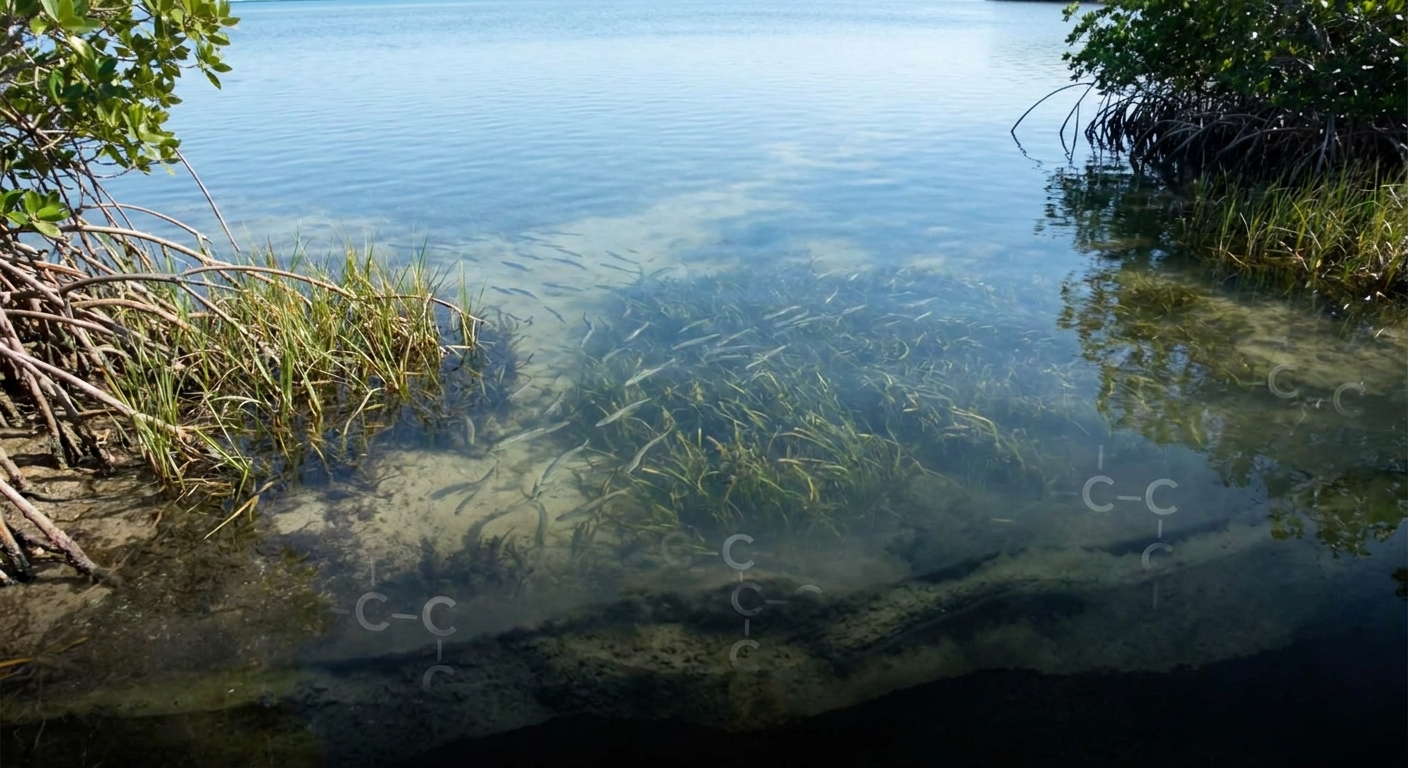
When we talk about climate solutions, we often look up—to forests, atmosphere, and clouds. But some of the most potent carbon vaults on Earth lie beneath the tides in seagrass meadows, mangrove forests, and salt marshes.
The Hidden Architecture of Blue Carbon
These coastal ecosystems occupy a tiny fraction of the planet’s surface yet punch far above their weight in carbon storage, shoreline protection, and biodiversity support.
What Makes Blue Carbon Different?
"Blue carbon" refers to carbon captured and stored by ocean and coastal ecosystems. The defining trait of blue carbon systems is that they store much of their carbon belowground in waterlogged sediments.
Key properties:
- Sediments are low in oxygen, slowing decomposition.
- Organic matter can accumulate for centuries to millennia.
- Disturbance (e.g., dredging, conversion to agriculture) can rapidly release this stored carbon.
A 2019 synthesis estimated that although vegetated coastal habitats cover less than 2% of the ocean, they account for roughly half of all carbon burial in marine sediments each year.
Species Profiles: The Engineers of Coastal Carbon
Seagrasses: Underwater Meadows
Seagrasses are flowering plants that evolved from terrestrial ancestors and re-entered the sea. They form dense meadows in shallow coastal waters.
Ecological roles:
- Slow water currents, enhancing sediment deposition
- Provide habitat and nursery grounds for fish and invertebrates
- Improve water clarity by trapping particles
Recent research has quantified that some seagrass meadows can store up to 500–600 metric tons of carbon per hectare in their sediments.
Notable species:
- Posidonia oceanica (Mediterranean): forms ancient meadows up to thousands of years old.
- Thalassia testudinum (Caribbean): vital habitat for manatees and green turtles.
Mangroves: Amphibious Forests
Mangroves are salt-tolerant trees that thrive in intertidal zones, with aerial roots that allow gas exchange and stability in soft sediments.
Key features:
- High aboveground biomass in trunks and branches
- Deep, organic-rich soils that can be several meters thick
- Complex root systems that trap sediments and organic matter
Studies indicate mangroves can store two to four times more carbon per hectare than most tropical rainforests when soil carbon is included.
Salt Marshes: Tidal Filters
Salt marshes—dominated by grasses and low shrubs—line temperate coastlines. They:
- Trap sediments and nutrients from land
- Stabilize shorelines against wave action
- Create mosaics of microhabitats for birds, fish, and invertebrates
Long-term core samples from marshes show vertically accreting layers of organic-rich sediments, building a natural ledger of carbon burial.
Blue Carbon Under Threat
Despite their importance, blue carbon ecosystems are among the most threatened on Earth.
Drivers of loss include:
- Coastal development (ports, housing, tourism)
- Aquaculture expansion (e.g., shrimp ponds in former mangroves)
- Pollution and nutrient loading
- Boat propeller scarring and destructive fishing
Global estimates suggest we have already lost:
- 30–50% of mangroves over the last half-century
- 29% of seagrass meadows since the late 19th century, with losses accelerating in recent decades
When these habitats are degraded or removed, previously stable carbon stocks can be oxidized and released as CO₂ and methane, turning sinks into significant emission sources.
New Research: Quantifying the Climate Payoff
Sediment Cores as Time Machines
Scientists reconstruct carbon burial histories using sediment cores—cylinders of mud and organic matter extracted from beneath mangroves, marshes, and seagrasses. By pairing radiometric dating (e.g., ²¹⁰Pb, ¹⁴C) with carbon content measurements, they can calculate burial rates over decades to centuries.
Findings show that typical burial rates in blue carbon systems are:
- Seagrass: ~80–100 g C/m²/yr
- Mangroves: ~150–200 g C/m²/yr
- Salt marsh: ~150–250 g C/m²/yr
These rates often surpass those of many terrestrial ecosystems when considering long-term, belowground storage.
Disturbance and Emissions
Recent case studies of mangrove conversion to aquaculture in Southeast Asia have measured large pulses of greenhouse gas emissions following disturbance.
Key observations:
- Up to 50–90% of soil carbon in the top meter can be lost within decades after clearing.
- This can represent hundreds of metric tons of CO₂-equivalent per hectare released to the atmosphere.
These data are driving efforts to incorporate blue carbon losses and gains into national greenhouse gas inventories and climate policies.
Conservation and Restoration: How to Protect Carbon Castles
1. Protect Intact Ecosystems First
Intact seagrass, mangrove, and marsh systems provide far more climate value than degraded sites, just as primary forests do on land.
Priority strategies:
- Expand legal protection for remaining high-integrity sites
- Integrate blue carbon into Marine Protected Area (MPA) networks
- Avoid policies that inadvertently push development into these zones
2. Restore Degraded Habitats Thoughtfully
Restoration is not trivial; success rates vary by ecosystem and context.
Mangrove restoration:
- Works best when hydrology is restored (natural tidal flow) rather than simply planting seedlings.
- Natural recolonization can outperform planted sites if conditions are right.
Seagrass restoration:
- Involves transplanting sods or seeding with harvested shoots.
- Requires addressing water quality—nutrient pollution and turbidity will doom plantings.
Salt marsh restoration:
- Often involves removing dikes or levees to reintroduce tidal flow.
- Sediment supply and elevation relative to sea level are critical.
Emerging research is quantifying how quickly restored areas regain their carbon sequestration functions, with some sites showing near-natural burial rates within a decade, while deep soil carbon stocks take far longer to rebuild.
3. Link Blue Carbon to Climate Finance
Because blue carbon stocks and fluxes are now better measured, they are starting to feature in carbon markets and climate finance mechanisms.
Promising approaches:
- REDD+-style programs adjusted for coastal wetlands
- Voluntary carbon projects that fund mangrove protection and restoration
- Integration of blue carbon into Nationally Determined Contributions (NDCs) under the Paris Agreement
Safeguards are essential to ensure that:
- Local communities retain access and rights to resources
- Projects are additional, verifiable, and durable
Biodiversity Bonus: More Than Just Carbon
Focusing solely on carbon risks oversimplifying the value of these systems. They also:
- Provide critical nurseries for commercially important fish and invertebrates
- Support migratory shorebirds and other wildlife
- Buffer coasts from storm surges and erosion, protecting human communities
For example, mangrove belts have been shown to reduce wave heights and storm energy, offering natural protection that can complement or sometimes replace hard infrastructure.
How Enthusiasts Can Engage with Blue Carbon Science
Observe and Report
Citizen science platforms can use your observations:
- Record mangrove, seagrass, or marsh locations and health on apps like iNaturalist.
- Participate in seagrass watch or shoreline monitoring programs.
Support Locally Rooted Projects
Prioritize initiatives that:
- Involve local and Indigenous communities in planning and governance
- Combine restoration with livelihood benefits, like sustainable fisheries or ecotourism
Advocate for Integrated Coastal Planning
At local or regional scales, push for:
- Coastal zone management that respects natural buffers
- Wastewater and runoff controls that keep water clear enough for seagrasses
A Quiet but Mighty Ally
Blue carbon ecosystems are not as visible as coral reefs or as iconic as whales, yet their role in stabilizing climate and coastlines is fundamental. As research deepens—from sediment core analyses to satellite mapping—our understanding of their global importance continues to grow.
For marine biology fans, they offer a compelling lesson: some of the ocean’s most powerful conservation wins will come not from charismatic megafauna but from protecting and restoring the humble plant communities that build carbon castles underwater.