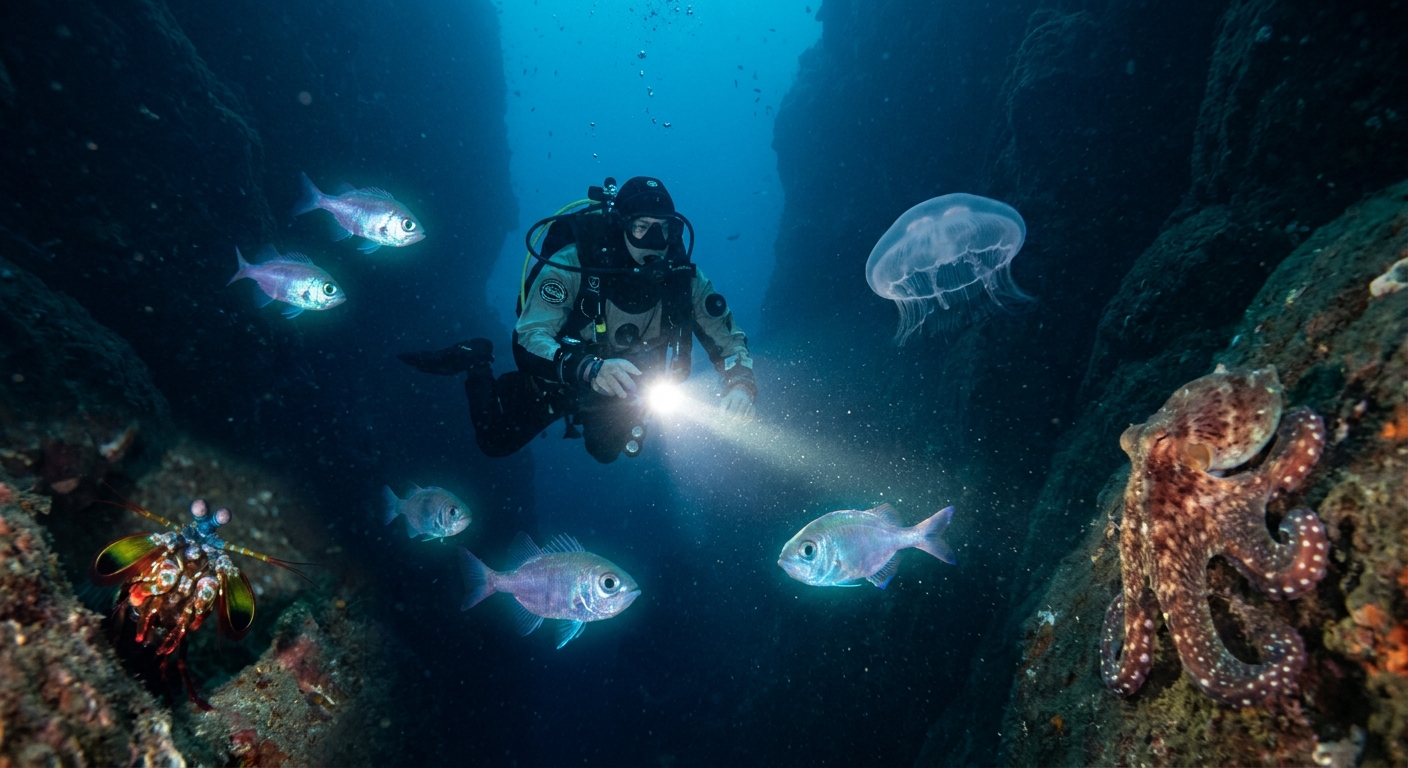
The ocean hosts some of the strangest life-forms on Earth—creatures that bend light, rewrite DNA, and survive pressures that would crush a submarine. Far from being mere curiosities, these species are pushing the frontiers of marine biology, medicine, and materials science.
Welcome to the Ocean’s Oddities Lab
This listicle explores nine of the most bizarre marine species known today, with a focus on what the latest research is revealing about their biology—and why scientists are so fascinated by them.
1. The Immortal Jellyfish (Turritopsis dohrnii)
The Trick: Biological Time Reversal
The so‑called "immortal jellyfish" can revert from its adult medusa stage back to its juvenile polyp stage under stress, effectively restarting its life cycle.
Recent genomic work published in 2022 in Proceedings of the National Academy of Sciences compared T. dohrnii with a closely related, non‑immortal species and found:
- Expanded gene families involved in DNA repair
- Enhanced systems for stem cell maintenance
- Altered regulation of cellular senescence pathways
Scientists hope that understanding these mechanisms will offer clues about aging and tissue regeneration in more complex animals.
2. Mantis Shrimp: Living Color Scientists
The Trick: Hyper‑Vision and Cavitation Punches
Mantis shrimps (order Stomatopoda) are famous for having some of the most complex eyes in the animal kingdom, detecting up to 12–16 types of photoreceptors (humans have three).
They can:
- See ultraviolet and polarized light
- Detect subtle color differences in reef environments
A 2020 study in Current Biology showed that mantis shrimp use circularly polarized light signals for private communication that many predators cannot detect.
Their club‑wielding species smash prey with such speed that they generate cavitation bubbles, briefly producing heat and light.
Engineers are studying mantis shrimp clubs for impact‑resistant composite materials—their layered structure inspires designs for helmets and aircraft panels.
3. The Yeti Crab (Kiwa spp.): Farming Bacteria in the Deep
The Trick: Hairy Arms as Microbial Gardens
Yeti crabs live around hydrothermal vents and cold seeps in the deep sea. Their claw and leg surfaces are covered in setae (hairlike structures) that host dense chemosynthetic bacterial communities.
These bacteria:
- Oxidize chemicals like hydrogen sulfide or methane
- Provide a primary food source for the crab
Recent in situ experiments with deep‑sea submersibles have used isotopic tracers to confirm that yeti crabs rely heavily on these bacterial farms.
Their symbiotic strategies highlight how life can thrive independently of sunlight, relying instead on chemical energy from Earth’s interior.
4. The Axolotl of the Sea: Sea Slugs That Steal Power Plants
The Trick: Photosynthetic Kleptoplasty
Some sacoglossan sea slugs, like Elysia chlorotica, consume algae and then retain the algae’s chloroplasts in their own cells, allowing them to perform photosynthesis.
This process, called kleptoplasty, was long thought to require horizontal gene transfer from algae to slug. Recent transcriptomic analyses, however, suggest the story is more nuanced:
- Slugs may rely on highly efficient uptake and maintenance systems rather than fully integrated algal genes
- The photosynthetic boost provides an energy safety net during food scarcity
These “solar‑powered” slugs are reshaping ideas about the boundaries between plant and animal lifestyles.
5. Barrel Eye Fish (Macropinna microstoma): Transparent Heads for Overhead Vision
The Trick: Rotating Eyes in a Fluid‑Filled Dome
Barrel eye fish inhabit deep midwater zones. They possess a transparent, fluid‑filled forehead dome that encases tubular eyes capable of rotating within the skull.
This setup allows them to:
- Look upward through their transparent head to spot faint silhouettes
- Rotate eyes forward when approaching prey
High‑definition ROV imaging in the Monterey Bay Submarine Canyon has given us rare footage of this fish in action, confirming that the dome likely helps protect sensitive eyes from jellyfish stings while maximizing light capture.
6. The Bobtail Squid–Bacteria Partnership
The Trick: Precision Light Camouflage
Hawaiian bobtail squid (Euprymna scolopes) harbor luminous bacteria (Vibrio fischeri) in a specialized light organ. At night, the squid uses the bacteria’s bioluminescence to counter‑illuminate itself, erasing its silhouette when viewed from below.
Recent research in host‑microbe interactions has used this symbiosis as a model system, revealing:
- How hosts select specific microbes from diverse seawater communities
- How bacterial signals shape host tissue development
The squid–Vibrio relationship has become a textbook example of mutualism and immune system training in marine animals.
7. Tardigrades at Sea: Micro‑Survivors in Marine Sediments
The Trick: Extreme Survival in Micro‑Worlds
While famously known from moss and freshwater, marine tardigrades also inhabit sandy sediments and deep‑sea environments.
They can survive:
- Extreme dehydration
- High radiation
- Temperature and pressure swings
A 2021 review in Marine Biodiversity highlighted their roles as micro‑predators and detritivores in benthic food webs. Their protective proteins, like Dsup (damage suppressor), which shields DNA from damage, have inspired research into improved radiation resistance for human cells in medical and space applications.
8. Greenland Sharks (Somniosus microcephalus): Slow‑Motion Giants
The Trick: Centuries‑Long Lifespans
Greenland sharks, residents of cold North Atlantic and Arctic waters, may be among the longest‑lived vertebrates. Radiocarbon dating of eye lens proteins suggests lifespans of at least 250–400 years.
Their biology is adapted to extreme cold and low metabolism:
- Sluggish movement
- Rare reproduction
- Late maturity (possibly over 100 years old)
Current research is probing their genome and physiology to understand how they maintain tissue integrity and avoid cancer and age‑related diseases over such long timescales.
Conservation concerns are rising: slow life histories make them particularly vulnerable to bycatch in Arctic fisheries.
9. Sea Spiders (Class Pycnogonida): Blood Without a Heart
The Trick: Circulation by Gut Pumping
Sea spiders are not true spiders, but arthropods with elongated legs and minimal bodies. Many species lack a centralized heart, using their gut movements to drive hemolymph flow through their limbs.
A 2021 study using micro‑CT scans and micro‑flow tracking found that:
- The gut branches deeply into the legs
- Rhythmic gut contractions help circulate oxygen and nutrients
This highly unconventional body plan is a reminder that evolution often improvises anatomical solutions that defy textbook norms.
Why Study Ocean Oddities?
Unusual marine species are more than trivia—they are natural experiments in biomechanics, symbiosis, longevity, and adaptation.
Their applications include:
- New insights into aging, regeneration, and DNA repair
- Templates for bio‑inspired materials and sensors
- Model systems for microbiome and immune research
For ocean enthusiasts, these creatures showcase just how inventive evolution can be. For scientists, they are powerful tools for asking—and answering—fundamental biological questions.
The ocean’s strangest neighbors remind us that life’s rulebook is far thicker than we once imagined.