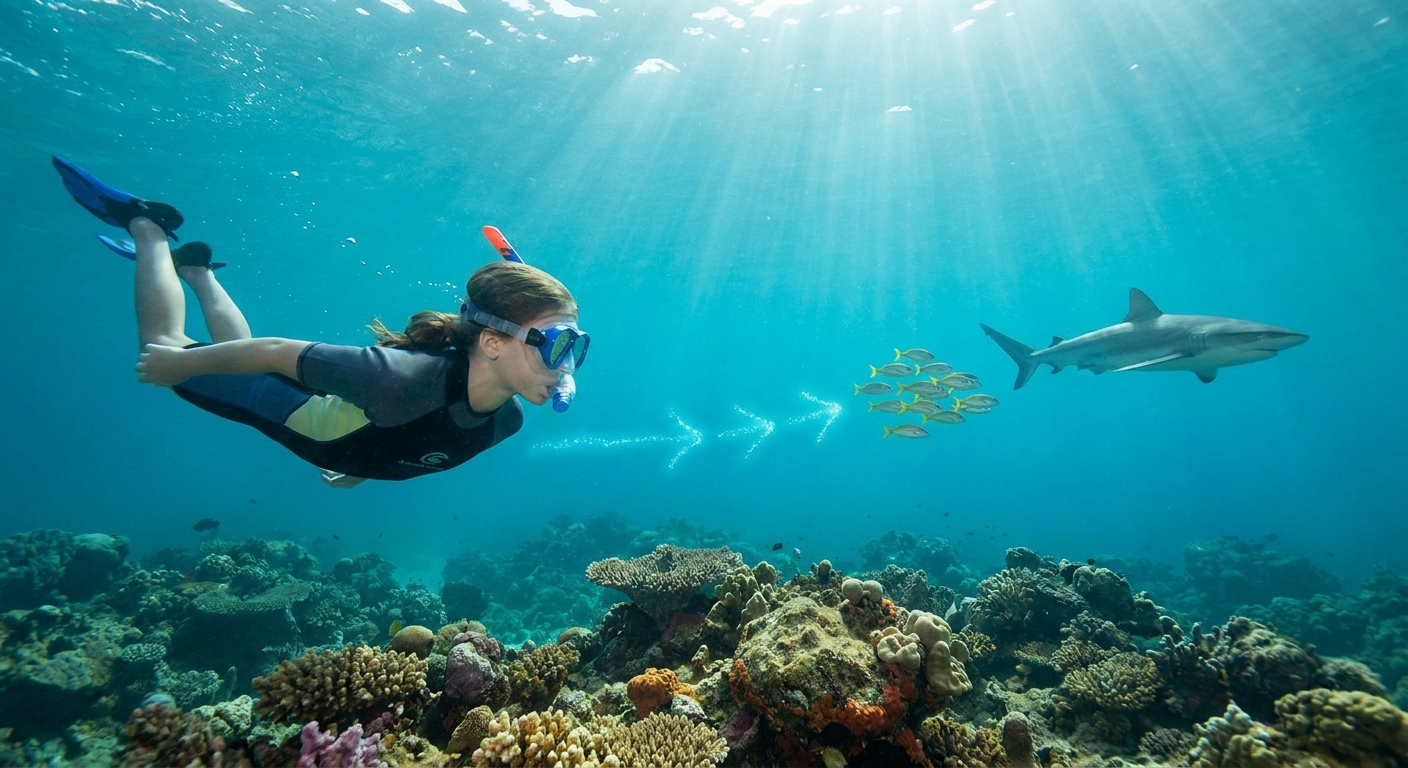
Every dive, snorkel, or tidepool visit is a brief chapter from a much longer ecological story. Understanding who eats whom—and why—turns a colorful scene into a living, dynamic system.
Why Learn to Read a Marine Food Web?
This guide walks you through the essentials of interpreting marine food webs, from microscopic plankton to apex predators, using current research and practical “in‑the‑field” tips for ocean enthusiasts.
Step 1: Start with the Base – Phytoplankton and Primary Producers
Marine food webs begin with organisms that capture energy, mostly through photosynthesis.
Key Groups to Know
- Phytoplankton: Microscopic algae (diatoms, dinoflagellates, coccolithophores) suspended in the water column
- Macroalgae (seaweeds): Kelp, red algae, green algae on reefs and rocky shores
- Seagrasses: Flowering plants forming meadows in shallow coastal zones
In the open ocean, phytoplankton do the heavy lifting, driving global primary production. Satellite data combined with autonomous floats (e.g., the biogeochemical Argo program) now allow scientists to track phytoplankton blooms and estimate carbon uptake across entire ocean basins.
Field Tip
On a sunny day, greenish or milky water near the surface can signal a phytoplankton bloom. Many jellyfish, small fish, and filter feeders will be more abundant in these areas.
Step 2: Meet the Middle – Zooplankton and Forage Fish
Between producers and predators sits a cast of intermediate consumers.
Zooplankton
These are animal drifters, ranging from microscopic crustaceans to gelatinous forms:
- Copepods: Tiny crustaceans; arguably the most numerous animals in the ocean
- Krill: Shrimp‑like crustaceans, vital in polar food webs
- Gelatinous zooplankton: Jellyfish, salps, ctenophores (comb jellies)
A 2021 study in Nature used DNA metabarcoding of zooplankton samples from the Atlantic and Pacific to show higher species diversity than previously recognized, especially among small, cryptic forms.
Forage Fish
Small, schooling species like anchovies, sardines, herring, and sand lance convert plankton into a form larger predators can use.
Acoustic surveys and tagging studies reveal that forage fish aggregations are tightly linked to plankton distribution, ocean fronts, and upwelling zones.
Field Tip
Look for bait balls—tight, shimmering schools of small fish. They are a visual clue that plankton is abundant and top predators may be nearby (seabirds, tuna, dolphins, sharks).
Step 3: Identify the Top – Predators, Both Obvious and Hidden
Apex Predators
These species sit at or near the top of local food webs:
- Sharks (e.g., reef sharks, tiger sharks)
- Large bony fish (tuna, groupers, snappers)
- Marine mammals (dolphins, seals, orcas)
Stable isotope analyses (looking at ratios of nitrogen and carbon isotopes in tissues) allow scientists to calculate trophic position and track energy flow into these predators.
Mesopredators
Not all predators are top dogs. Mid‑level predators—like larger reef fish, squid, or small sharks—shape the abundance and behavior of their prey and can expand when apex predators are removed.
A 2020 meta‑analysis in Ecology Letters showed that overfishing apex predators often leads to a mesopredator release, with cascading effects on lower trophic levels and habitat structure.
Field Tip
On reefs, watch where predatory fish hang out—often near cleaning stations, bommies (isolated coral heads), or current‑swept corners. Their presence signals a robust prey base.
Step 4: Add the Detour – Detritus and Decomposers
Food webs aren’t just linear chains; they’re networks with major detours.
Detrital Pathways
Dead organisms, fecal pellets, and shed material (like kelp fragments) sink or accumulate as detritus. This organic matter fuels:
- Bacteria and archaea
- Detritivores like worms, sea cucumbers, and some crustaceans
Deep‑sea food webs rely heavily on this “marine snow.” Autonomous sediment traps and deep‑sea cameras have revealed complex communities thriving thousands of meters below the surface, sustained by a continual rain of particles.
Field Tip
In seagrass beds or mangrove lagoons, stir the sediment gently: you’ll often see clouds of fine organic matter and small scavengers—evidence of the detrital engine at work.
Step 5: Recognize Special Roles – Keystone and Foundation Species
Some species exert disproportionate influence on their ecosystems.
- Keystone predators (e.g., sea otters on kelp forests, starfish on rocky shores) regulate prey populations and prevent monopolies
- Foundation species (e.g., corals, mangroves, seagrasses) create physical habitats used by myriad other species
Long‑term experiments on rocky shores and coral reefs show that removing these players can trigger rapid, large‑scale community shifts.
Field Tip
When snorkeling a reef, note which structures dominate: branching corals, massive boulders, or fleshy algae. Their identity and health often indicate which key species are thriving or missing.
Step 6: Factor in Human Impacts
Humans now shape marine food webs at every level.
Overfishing and Trophic Downgrading
Targeting large predators can lead to:
- Increased mesopredators and herbivores
- Algal overgrowth on reefs when herbivores are also removed
A 2019 global assessment showed that many coastal systems are undergoing trophic downgrading—a loss of higher trophic levels—altering everything from fish behavior to disease prevalence.
Climate Change and Range Shifts
Warming waters drive species poleward and deeper. For example:
- Tropical herbivorous fish expanding into temperate reefs, changing algal communities
- Shifts in plankton species composition, affecting the diets of higher consumers
New biophysical models incorporating temperature, currents, and life history traits are helping scientists predict future food web configurations under various emissions scenarios.
Step 7: Practice Reading Food Webs in the Field
Next time you’re in or on the water, try this step‑by‑step mental exercise:
Spot the producers: Is there macroalgae, seagrass, or signs of phytoplankton blooms?
Look for grazers and filter feeders: Snails, urchins, small fish, bivalves
Scan for mid‑level predators: Reef fish, squid, octopus
Search for apex predators or indicators: Larger fish, sharks, marine mammals, or diving seabirds
Note the habitat formers: Corals, mangroves, kelp—and their condition
Consider what’s missing: Are urchin barrens present? Are big predators rare in a seemingly healthy habitat?
Photograph what you see and compare it later to regional species guides and food web diagrams to refine your understanding.
How Citizen Science Can Help
Many programs invite divers and snorkelers to document marine species and interactions:
- Reef Life Survey and Reef Check
- iNaturalist marine projects
- Local seagrass or intertidal monitoring initiatives
These contribute valuable data to scientists investigating food web shifts, species invasions, and climate‑driven changes.
The Payoff: Seeing the Ocean as a System
Learning to read marine food webs transforms casual wildlife watching into a form of field ecology. Each fish, crab, or jelly becomes a clue to energy pathways, ecosystem health, and broader ocean processes.
For marine biology fans, this systems view is deeply satisfying: the next time you slip beneath the surface, you won’t just see species—you’ll see relationships, roles, and stories written in water and light.