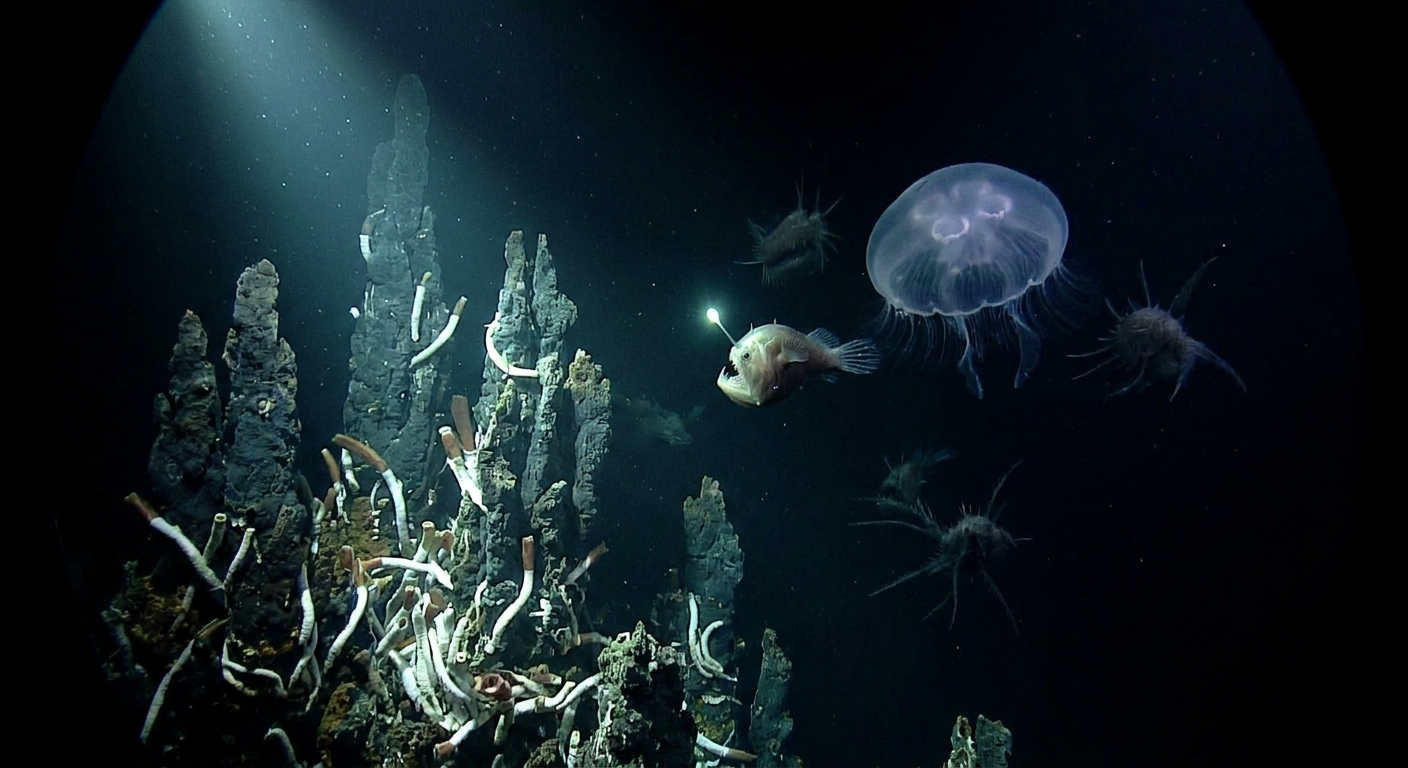
When sunlight disappears around 200 meters below the ocean’s surface, a different planet effectively begins. This is the deep sea: a realm of crushing pressures, near‑freezing temperatures, and perpetual night that stretches down to more than 11,000 meters. Despite these extremes, the deep ocean is Earth’s largest living space and home to extraordinary life forms that challenge our assumptions about what biology can do.
Welcome to Earth’s Largest, Least-Known Habitat
Marine biologists now recognize the deep sea not as a biological desert, but as a thriving, intricate ecosystem. Recent advances in remotely operated vehicles (ROVs), autonomous underwater vehicles (AUVs), and high‑pressure lab experiments are rewriting the field almost yearly.
The Architecture of the Deep: Twilight, Midnight, and Beyond
Scientists often divide the deep ocean into zones based on light and depth:
- Mesopelagic (Twilight Zone, ~200–1,000 m)
Dim blue light, enough for silhouettes but not photosynthesis. Many organisms migrate vertically, feeding near the surface by night and descending by day.
- Bathypelagic (Midnight Zone, ~1,000–4,000 m)
No sunlight. Constant cold (~4°C), immense pressure, and weak but persistent "marine snow"—organic particles falling from above.
- Abyssopelagic and Hadal Zones (~4,000–11,000 m)
Vast plains and trenches. Temperatures near freezing, pressures exceeding 1,000 atmospheres. Life is sparse but uniquely adapted.
Each zone supports its own communities, with gradients in pressure, temperature, and food availability shaping who can survive where.
Energy Without Sun: Chemosynthesis and Marine Snow
Without sunlight, how does life persist?
Marine Snow: The Slow Rain of Life
Most deep‑sea ecosystems run on marine snow—a continuous fall of organic debris, including plankton corpses, fecal pellets, mucus, and fragments of larger organisms. Recent work using sediment traps and optical sensors shows that this flux is highly patchy and seasonal, pulsing with phytoplankton blooms at the surface.
A 2023 study using deep‑profiling floats revealed that short, intense pulses of marine snow can deliver up to 40% of the annual carbon flux in just a few weeks, creating temporary “feasts” in otherwise food‑poor regions.
Chemosynthesis: Life From Chemical Energy
The most dramatic deep‑sea communities cluster around hydrothermal vents, cold seeps, and whale falls where chemical energy is abundant. Here, microbes power ecosystems by chemosynthesis, using chemicals instead of sunlight to fix carbon.
- Hydrothermal vents: Bacteria and archaea oxidize hydrogen sulfide and methane from hot fluids. They form the base of food webs supporting giant tubeworms, vent crabs, and eyeless shrimp.
- Cold seeps: Methane and sulfide leak from sediments at much lower temperatures. Microbes form mats and symbioses with clams and mussels.
New genomic work on vent microbes has uncovered metabolic pathways that appear nowhere else, including enzymes that allow the use of multiple energy sources simultaneously—an advantage in unstable vent environments.
Deep‑Sea Survival Strategies: Extreme Adaptations
Life in the deep sea faces three main challenges: pressure, scarcity, and darkness. Evolution has delivered ingenious solutions.
1. Pressure‑Proof Bodies
At 4,000 m, pressures exceed 400 times atmospheric levels. To cope, deep‑sea animals:
- Minimize gas‑filled spaces (few or no swim bladders)
- Use flexible cartilage instead of rigid bone
- Stabilize proteins and membranes with special molecules
Recent research on hadal snailfish from the Mariana Trench revealed high levels of trimethylamine N‑oxide (TMAO), a compound that helps proteins maintain structure under intense pressure. Interestingly, these fish carry so much TMAO that their tissues are among the saltiest of any vertebrate.
2. Bioluminescence: Making Light in the Dark
Up to 75–90% of midwater animals may be capable of bioluminescence. They use it for:
- Counterillumination: Matching downwelling moonlight to erase their silhouette from predators below
- Lures: Like the anglerfish’s iconic glowing lure
- Communication: Courtship signals in lanternfish and dragonfish
Recent camera systems tuned to extremely low light have captured complex light displays that suggest some deep‑sea fishes may have species‑specific “codes” of flashes and patterns, a kind of luminous language.
3. Slow Lives, Big Mouths
Food is unpredictable. Many deep‑sea animals:
- Grow slowly and live long (some deep‑sea corals are over 4,000 years old)
- Have oversized mouths and extendable stomachs to capitalize on rare large meals
- Use ultra‑efficient metabolisms to stretch scarce calories
Species Profiles: Icons of the Deep
Vampire Squid (Vampyroteuthis infernalis)
Despite the intense name, the vampire squid is a small, delicate creature adapted to low‑oxygen zones around 600–900 m. It doesn’t hunt actively; instead, it collects marine snow with mucus‑covered filaments. Its bioluminescent displays and “cloak” posture—arms wrapped over its body—make it a favorite subject in deep‑sea documentaries.
Giant Tube Worm (Riftia pachyptila)
These vent specialists lack mouths and guts. Instead, they host dense communities of chemosynthetic bacteria in a special organ called a trophosome. The worms supply sulfide and oxygen via their blood; the bacteria supply organic carbon in return. Genomic analyses have shown that these symbiotic bacteria can switch between different sulfur compounds, allowing them to adapt as vent chemistry changes.
Snailfish of the Trenches
Hadal snailfish hold the record for deepest known fish, observed at ~8,300 m. Their bodies are soft and gelatinous, with thin skulls and minimal mineralization. New ROV footage shows them hunting amphipods with surprising agility, suggesting that even at extreme depths, behavioral complexity persists.
New Tools, New Discoveries
The deep sea is no longer out of reach. Key technologies include:
- Hybrid ROV/AUV systems that can map seafloor in high resolution and then dive for targeted sampling
- Environmental DNA (eDNA) analyses, which detect genetic traces in seawater and sediments, revealing species that cameras never see
- In situ high‑pressure incubators, allowing microbes and small animals to be studied at natural pressures
A 2022 global eDNA survey of the deep pelagic ocean found hundreds of previously unknown lineages of protists and small animals, suggesting that our current species inventory is only a fraction of reality.
Why the Deep Sea Matters to a Warming World
Though remote, the deep ocean is tightly linked to Earth’s climate and surface ecosystems:
- It stores vast amounts of heat and carbon, buffering climate change
- It hosts long‑lived species that record environmental shifts over millennia
- It influences nutrient return to the surface via upwelling and mixing
Changes at the surface—warming, acidification, altered productivity—cascade downward by changing marine snow quality and oxygen levels. Observatories have already documented declining oxygen in midwater layers, compressing the habitable space for many species.
Threats and Conservation Frontiers
Human impacts are booming faster than our understanding.
Deep‑Sea Mining
Proposed mining of polymetallic nodules and seafloor massive sulfides could disturb vast areas. Experimental studies show that tracks from mining simulations remain visible for decades, with slow or incomplete recovery of communities.
Climate Change and Acidification
- Warming alters density and mixing, potentially changing food delivery
- Acidification affects calcifying organisms like corals and foraminifera, many of which are key habitat builders or carbon sinks
Pollution
Microplastics and chemical contaminants have been found in trenches and deep sediments. Deep‑sea creatures at the top of food webs, including some fishes and cephalopods, already show contaminant loads that raise questions about long‑term health.
How You Can Engage With the Deep (From the Surface)
You don’t need a submersible to support deep‑sea science and conservation:
- Follow expeditions live: Many research cruises stream ROV dives in real time (e.g., NOAA Ocean Exploration, Schmidt Ocean Institute)
- Support open data: Organizations like OBIS and MBARI provide public access to deep‑sea data and imagery
- Advocate for precautionary policies: Especially around deep‑sea mining and high‑seas protections
A Frontier of Questions, Not Answers
The deep sea remains the planet’s greatest wilderness. For every elegant adaptation explained, new mysteries surface: How many species live in the midnight waters between seafloor and surface? How will deep communities respond to accelerated climate change? Are there still entirely unknown forms of metabolism awaiting discovery in vent and seep microbes?
For ocean enthusiasts and marine biology fans, the deep sea is not just a destination; it’s a reminder that Earth is still a world of frontiers. In the darkness, life keeps rewriting the rules.