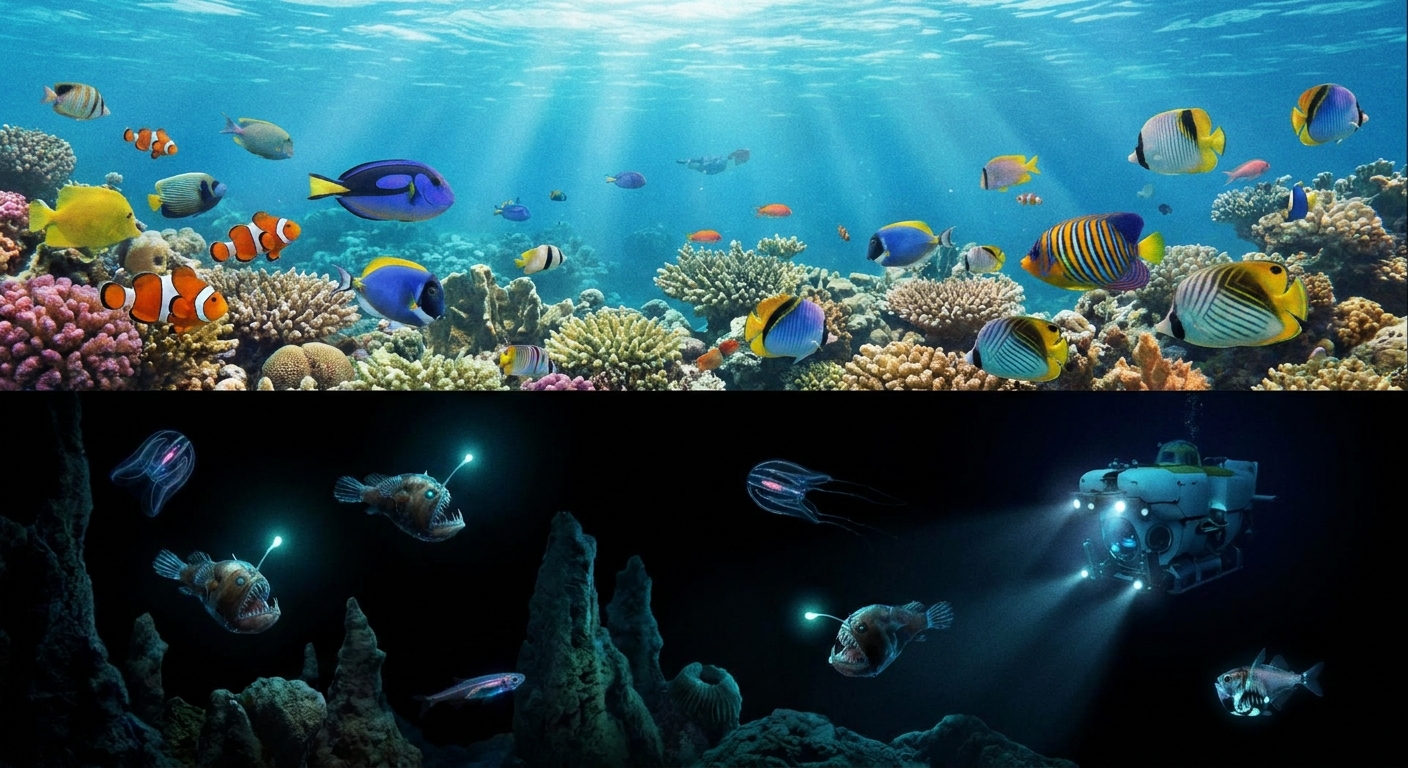
At first glance, “the ocean” seems like a single entity. For marine biologists, it’s more useful to think of two broad worlds:
Two Oceans on One Planet
- The coastal and surface oceans: sunlit, nutrient‑rich, vigorously mixed, and heavily influenced by land.
- The deep sea: dark, cold, high‑pressure, and far more stable—but with remarkably different rules for life.
Comparing these realms reveals how environment sculpts biology, from metabolism to lifespan, and why the deep sea is central to global change science.
Light and Energy: Photosynthesis vs. Falling Debris
Coastal & Surface Oceans
- Light: Abundant in the upper ~200 m.
- Primary energy source: Photosynthesis by phytoplankton, seagrasses, and macroalgae.
- Productivity: Often high, especially in upwelling zones and estuaries.
Food webs here resemble terrestrial systems: sunlight feeds primary producers, which sustain grazers and predators. Nutrient inputs from rivers and upwelling fuel blooms.
Deep Sea
- Light: Essentially absent below ~1,000 m.
- Primary energy sources:
- Marine snow (sinking organic matter)
- Larger falls (jellyfish, fish carcasses, whale falls)
- Chemosynthesis at vents and seeps
Productivity is low and patchy. Most deep‑sea ecosystems are detritus‑driven, relying on the trickle (and occasional avalanche) of carbon from above. Hydrothermal vents and cold seeps are exceptions, powered by chemical gradients rather than light.
Recent carbon flux studies show that short, intense pulses of organic matter can drive disproportionate activity in the deep, creating feast‑and‑famine dynamics unseen in most coastal systems.
Physical Conditions: Variability vs. Stability
Coastal & Surface Oceans
Conditions are variable on scales from hours to seasons:
- Rapid swings in temperature, salinity, and turbidity
- Strong storms and waves
- Frequent disturbance (sediment resuspension, hypoxia events)
Many coastal organisms are adapted to flexibility: broad tolerances and rapid reproduction.
Deep Sea
Below the main thermocline, conditions are often remarkably stable:
- Temperatures hover near 2–4°C for centuries.
- Salinity and density change slowly.
- Light doesn’t vary with seasons.
The main gradients are pressure and food availability, both changing with depth and topography.
Yet stability does not mean uniformity. Features like seamounts, canyons, and vents create sharp microhabitats. High‑resolution profiling has revealed fine‑scale layering of oxygen and particles, hinting at complex, small‑scale structuring of life.
Life Histories: Fast and Furious vs. Slow and Steady
Coastal & Surface Oceans
- Many species grow quickly and reproduce early.
- Short lifespans are common, especially among small fish and invertebrates.
- Populations can rebound quickly after disturbance—if habitat remains intact.
This strategy matches ephemeral conditions: when nutrients appear, you bloom; when conditions degrade, you crash, leaving resting stages or spores.
Deep Sea
The deep favors slow, long‑lived strategies:
- Deep‑sea corals and sponges can live for thousands of years.
- Many fishes mature late and have low reproductive rates.
- Growth is limited by consistently low food inputs.
Radiometric dating and otolith (ear bone) analyses have revealed deep‑sea fish species reaching ages well over a century, with growth curves far flatter than their shallow relatives.
This makes deep‑sea communities highly vulnerable to overexploitation. Recovery from disturbance is measured in decades to centuries.
Body Plans and Adaptations: Form Fits the Depth
Comparing Key Traits
Buoyancy and Skeletons
- Coastal fish often have well‑developed bones and swim bladders. - Deep‑sea fishes reduce calcification and gas spaces to withstand pressure.
Sensory Systems
- Coastal species rely heavily on vision and sometimes color patterns. - Deep‑sea species emphasize light detection (even faint bioluminescence), mechanosensory systems, and chemoreception.
Bioluminescence
- Rare in coastal shallows (limited to certain jellies, dinoflagellates, and a few fishes and squids). - Near‑ubiquitous in the deep midwaters; used for camouflage, luring prey, and communication.
Metabolism
- Coastal species often maintain high metabolic rates to support active lifestyles. - Deep‑sea species commonly have reduced metabolic rates, conserving energy between rare meals.
Recent transcriptomic work shows pressure‑adapted proteins and membranes in deep species, including alterations in enzymes and structural proteins that maintain function at high pressures.
Biodiversity and Endemism: Hotspots in Different Places
Coastal & Surface Oceans
Biodiversity hotspots cluster in tropical coral reefs, kelp forests, and estuaries. Many species have wide geographic ranges but are confined to certain temperature bands.
Deep Sea
Deep‑sea diversity is more cryptic:
- Seamounts, ridges, and canyons host rich, often endemic communities.
- Cold‑water coral reefs and sponge grounds act as island‑like hotspots.
- Hadal trenches show high endemism, with many lineages restricted to single trenches.
eDNA and imaging surveys often find high local diversity but low abundance, with many species represented by just a few individuals.
Comparative studies suggest that while coastal habitats may host more species per unit area, the deep sea contributes heavily to global phylogenetic diversity—unique branches on the tree of life.
Ecological Roles: Carbon Highways and Climate Engines
Coastal & Surface Oceans
- Major sites of primary production and fisheries.
- Key zones for air–sea gas exchange, influencing immediate climate feedbacks.
- Sensitive to land‑based pollution and nutrient runoff.
Deep Sea
- Acts as a long‑term carbon sink, via the biological pump.
- Stores over 90% of excess heat accumulated from global warming.
- Modulates climate over decades to centuries through deep water formation and circulation.
Biogeochemical comparisons highlight that coastal processes often determine how much carbon leaves the surface, while deep‑sea processes determine how long it stays away from the atmosphere.
Human Impacts: Visible vs. Hidden Footprints
Coastal & Surface Oceans
Impacts are obvious and heavily studied:
- Overfishing and bycatch
- Eutrophication, hypoxia, harmful algal blooms
- Plastic pollution, coastal development, habitat loss
Management frameworks (MPAs, fisheries regulations, restoration projects) are relatively mature, even if imperfectly implemented.
Deep Sea
Impacts are emerging, often before baselines are fully known:
- Deep‑sea fishing targets slow‑growing species; bottom trawls damage corals and sponges.
- Deep‑sea mining proposals threaten nodule fields, hydrothermal vents, and sediment ecosystems.
- Climate‑driven warming, deoxygenation, and acidification propagate gradually but inexorably into the abyss.
Comparative vulnerability studies warn that deep‑sea species’ slow life histories make them far less resilient to exploitation than many coastal counterparts.
Conservation Strategies: Different Tools for Different Depths
Coastal & Surface Oceans
- Marine protected areas often focus on spatial closures around reefs, mangroves, and spawning grounds.
- Fisheries can sometimes be managed adaptively due to shorter generation times.
- Restoration (e.g., coral gardening, seagrass planting) is feasible at human scales.
Deep Sea
- Conservation emphasizes avoidance of damage: once ancient structures are destroyed, natural recovery is extremely slow.
- Designation of Vulnerable Marine Ecosystems (VMEs) prioritizes deep corals, sponges, and seamounts.
- Emerging frameworks (e.g., the High Seas Treaty) aim to create MPAs beyond national jurisdictions.
Scientific priorities differ too:
- Coastal: fine‑scale management, socio‑ecological integration.
- Deep: basic mapping, species discovery, and precautionary policy in the face of uncertainty.
What Each Realm Teaches Us About the Other
The contrast between deep and coastal oceans is not just academic:
- Deep‑sea studies show how life persists under energy limitation, informing theories of ecosystem stability and resilience.
- Coastal work demonstrates rapid evolutionary and ecological responses to disturbance.
Together, they remind us that:
- Marine life is extraordinarily plastic in form and function.
- Human activities can alter both fast and slow systems—sometimes irreversibly.
For ocean enthusiasts, embracing both worlds enriches our sense of the sea: a place where kelp forests and coral reefs flicker in sunlight while, kilometers below, bioluminescent predators roam over ancient sponge gardens.
Protecting the ocean means thinking across this full spectrum—from surf zones to trenches—and recognizing that the deep sea is not a distant “other ocean,” but the foundation upon which coastal life, and our climate, ultimately rest.