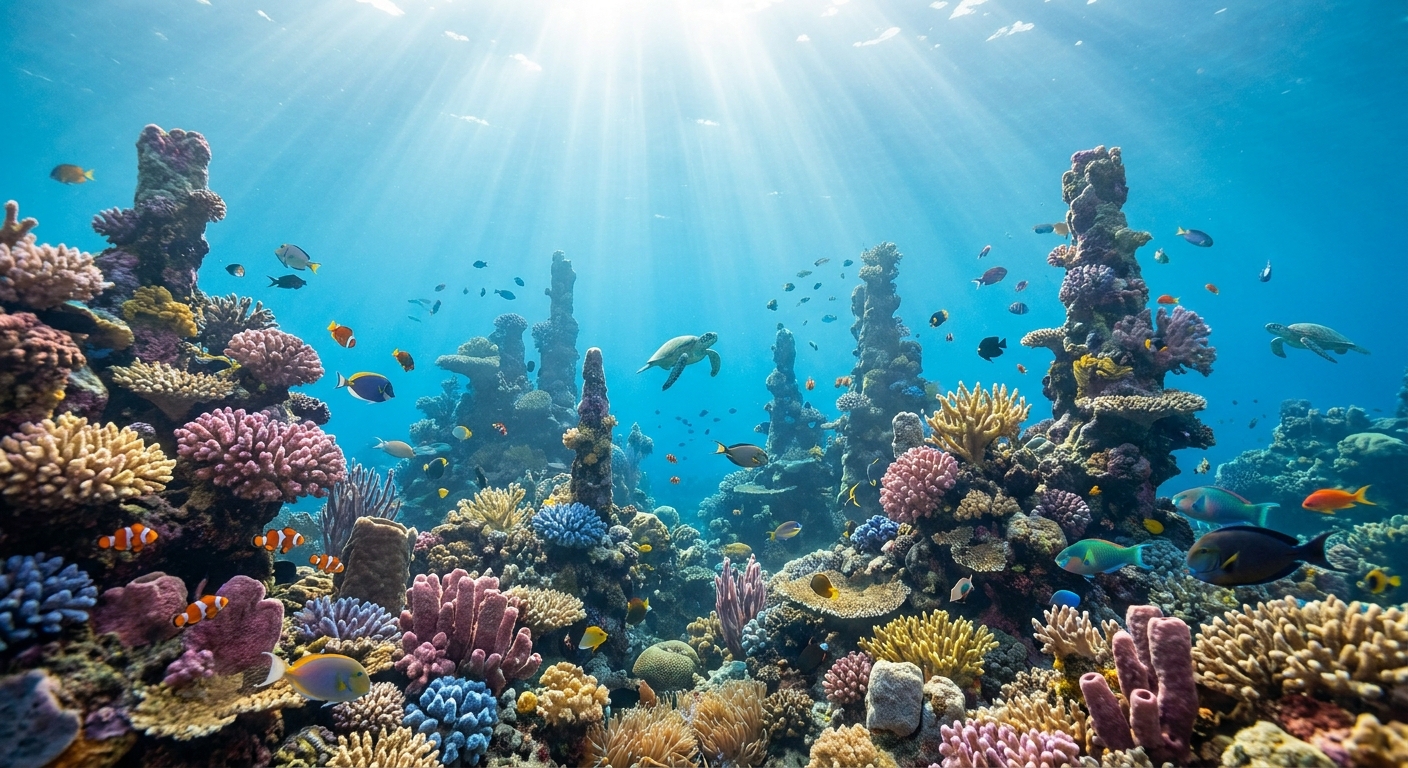
Slip beneath the surface in any tropical sea and the water begins to glow with color: branching thickets of staghorn coral, boulder-sized brain corals etched with labyrinthine grooves, plates and shelves like rose petals turned to stone. These are coral reefs—living cities engineered by tiny animals that have quietly shaped ocean life for more than 200 million years.
The Living Architecture Beneath the Waves
To the casual eye, corals look like plants or rocks. In reality, they are colonies of animals—coral polyps—working in slow motion to build some of the most complex and biodiverse habitats on Earth.
What Exactly Is a Coral?
A coral polyp is a small, tentacled animal related to jellyfish and sea anemones. A single polyp is only a few millimeters wide, but together, polyps form colonies that can span meters.
Each polyp:
- Sits in a cup-shaped limestone (calcium carbonate) skeleton
- Extends tentacles at night to capture plankton
- Hosts microscopic algae called zooxanthellae (mostly dinoflagellates of the family Symbiodiniaceae) in its tissues
This partnership is the engine of reef-building. The algae photosynthesize, producing sugars that fuel coral growth, and in return gain shelter and access to carbon dioxide and nutrients. Up to 90% of a coral’s energy can come from these algae.
Over centuries, the combined skeletons of millions of polyps form the reef’s massive calcium carbonate framework. This “biogenic rock” then becomes the foundation for an entire ecosystem.
A Three-Dimensional Engine of Biodiversity
Coral reefs cover less than 1% of the seafloor yet support an estimated 25% of all marine species. Why so much life in such a small area? The answer is structural complexity.
Reefs create:
- Sheltered crevices for cryptic fishes, shrimps, crabs, and worms
- Vertical walls and overhangs that generate gradients of light, current, and temperature
- High-friction surfaces that slow water and allow plankton and larvae to settle
Recent 3D mapping studies using drones and structure-from-motion photogrammetry have shown that reefs with higher topographic complexity (more nooks, arches, and overhangs) host significantly more fish biomass and species richness.
The Reef as a Multi-Level City
Think of a reef as a high-rise city:
- Ground level (reef base): Home to sponges, encrusting corals, burrowing clams, and worm-tube gardens
- Mid-level ledges: Hunting grounds for groupers, snappers, and octopus
- Upper canopy (branching corals): Neighborhoods for damselfish, anthias, and chromis schools
- Open-water outskirts: Patrolled by jacks, sharks, and tuna
Every niche—every tiny cave, shaded underside, and exposed ridge—can host a different community.
Species Profiles: The Builders, the Cleaners, and the Predators
1. Staghorn Coral (Acropora cervicornis)
Once among the dominant reef builders in the Caribbean, staghorn corals grow rapidly, forming dense thickets that shelter juvenile fishes. After drastic declines due to disease and bleaching, restoration programs now grow fragments in underwater "coral nurseries" and transplant them back to damaged reefs.
Key traits:
- Fast growth (up to 10–20 cm per year in ideal conditions)
- Highly sensitive to warming and disease
- Critical habitat for young reef fish
2. Cleaner Wrasse (Labroides dimidiatus)
These small, colorful fish run "cleaning stations" where larger fish queue to have parasites removed. Recent experiments show cleaner wrasse recognize individual clients and even pass a version of the mirror self-recognition test, challenging assumptions about fish cognition.
Their role:
- Reduce parasite loads on reef fish
- Influence fish behavior and even reproductive success
- Serve as keystone mutualists—removing them can reduce overall fish diversity
3. Crown-of-Thorns Starfish (Acanthaster cf. solaris)
A dramatic reef predator, the crown-of-thorns starfish (COTS) feeds on live coral tissue, leaving white scars of exposed skeleton. While natural at low densities, outbreaks—often linked to nutrient pollution and loss of natural predators—can devastate coral cover.
New research uses:
- Robotic COTS hunters to autonomously locate starfish
- Biocontrol trials based on semiochemicals that attract starfish for targeted removal
Recent Research: A Rapidly Changing Field
Heat-Resistant Corals and Super Symbionts
With marine heatwaves becoming more frequent, scientists are racing to understand why some corals tolerate heat better than others.
Recent findings include:
- Some corals host thermotolerant algae (e.g., Durusdinium spp.) that survive higher temperatures but may reduce coral growth under normal conditions.
- Experiments in "assisted evolution" expose corals and their symbionts to repeated heat stress, selecting lineages more tolerant to future warming.
- Multi-omic studies (combining genomics, transcriptomics, and proteomics) are revealing specific genes and metabolic pathways linked to heat resilience.
The Microbiome: Corals as Holobionts
Corals are not just coral + algae. They are holobionts: complex assemblages of animal, algae, bacteria, archaea, fungi, and viruses.
New microbiome research shows:
- Beneficial bacteria help corals resist disease and process nitrogen
- Dysbiosis (microbial imbalance) often precedes visible disease or bleaching
- "Probiotic" treatments—adding beneficial bacteria—can sometimes improve coral health under stress in lab settings
Ecosystem Services: Beyond Beauty
Coral reefs provide services that extend far beyond the dive site:
- Coastal protection: Reef structures dissipate up to 97% of incoming wave energy, shielding shorelines from erosion and storm damage.
- Fisheries: An estimated 6 million people directly rely on reef fisheries for food and income.
- Tourism: Reef-related tourism generates tens of billions of dollars annually.
- Pharmaceutical potential: Reef organisms produce novel compounds with anticancer, antiviral, and anti-inflammatory properties, some already in clinical use.
Economic valuation studies suggest the global annual value of coral reefs is in the hundreds of billions of dollars when considering all services.
Conservation in an Era of Change
Coral reefs face multiple, interacting threats:
- Ocean warming and marine heatwaves
- Ocean acidification
- Pollution and sedimentation
- Overfishing and destructive fishing
- Disease outbreaks
Yet there is a surge of innovation in reef conservation.
1. Coral Gardening and Reef Restoration
Organizations now:
- Grow corals in underwater nurseries (ropes, trees, or frames)
- Use microfragmentation—cutting corals into tiny pieces that grow faster and fuse into larger colonies
- Outplant heat-tolerant genotypes identified via field performance and genetic screening
While restoration cannot substitute for emissions reductions, it can:
- Buy time for vulnerable ecosystems
- Preserve genetic diversity
- Restore local ecosystem function in degraded but otherwise manageable sites
2. Marine Protected Areas 2.0
New approaches to MPAs emphasize:
- Climate-smart design—including depth and thermal refugia
- Networks of reserves that maintain larval connectivity
- Dynamic closures that adjust based on real-time data, such as coral bleaching forecasts
Remote sensing tools (e.g., satellite-based reef temperature monitoring and global coral bleaching alerts) are now guiding managers more precisely than ever.
Why Coral Reefs Matter to the Future Ocean
Coral reefs are not passive victims of climate change; they are dynamic, evolving systems. Some reefs will be lost. Others may transform, favoring hardier coral species, sponges, or macroalgae. The question is not simply "Will reefs survive?" but "What kind of reefs will we have, and where?"
For ocean enthusiasts and marine biology fans, the challenge is also an invitation: to document, understand, and advocate for these ecosystems while they are still astonishingly rich—and to support the science and policies that might yet allow coral cities to thrive in a warmer world.
Beneath every sunlit wave, the architects are still building.